Wednesday, June 5, 2013

The Lost Pilot(s) Matter

Though television ultimately put an end to radio drama as a mainstream form of entertainment, the medium also gave second (and, in many cases) longer lives to of radio's best loved dramas. Sometimes the shows had completely different casts, such as Gunsmoke where the radio cast was never seriously considered, while others were very much the same as their radio incarnations. Jack Webb's Dragnet and the soap opera Guiding Light are two such programs, the latter being the ultimate example by virtue of the TV and radio versions having been produced simultaneously for a number if years using the same scripts and cast.

Many other radio shows fell quickly into obscurity in television's wake, and others gave it their best shot but fell a bit short. The latter was Yours Truly Johnny Dollar's fate. Not surprisingly, considering the off-beat nature of the radio version, the attempt to transfer the program to television has a murky history in its own right.

One of the few things that's certain is that at least one Johnny Dollar pilot got made. Produced in 1962 by Blake Edwards, who also wrote for the radio series, it starred character actor William Bryant in the title role and martial-arts pioneer Ed Parker is known to have worked on it in some capacity. Beyond that, very little else is clear.

It's not even clear whether this was the only attempt at adapting Yours Truly, Johnny Dollar for television. In his book The Encyclopedia of Television Pilots, media historian Vincent Terrace refers to the 1962 pilot as the second attempt but there's very little that can be determined about this predecessor. A pre-1962 timeframe, when the radio show was still going, suggests that this earlier version would be the one for which Bob Bailey was supposedly rejected for not being the right physical type, but even that's pure speculation. The main thing we know is that the efforts to put Johnny Dollar on TV were ultimately unsuccessful.

That's probably for the best, though, because I don't think the medium would have been kind to the man with the action-packed expense account. On radio, Dollar's narration could take us anywhere in the world and, though they occasionally got details wrong (as any Maryland resident who's listened to "The Chesapeake Fraud Matter" can attest), it was always believable. The budget restraints of television would not have been so forgiving. Similarly, the supporting characters couldn't possibly be quite as colorful as those that populated the radio series. Even if Bob Bailey had played the title character on-screen, the character of the show would have been fundamentally different. Fortunately, we'll always have radio.

Saturday, May 18, 2013

The Wit & Wisdom Matter

Very often the finest moment of any story on Yours Truly, Johnny Dollar comes at the end when Johnny finishes his report and offers his remarks on the case. In many ways, particularly during Bob Bailey's tenure, it was a microcosm of what made the show so great. Even in a genre whose success often hinged on the quality of the main character's narration, Bailey's delivery of the various writers' sardonic dialogue under Jack Johnstone's direction typically added up to something special.

Two particular examples have stuck with me as I've been revisiting these programs, one from The Cui Bono Matter (by Les Crutchfield) and the other from The Markham Matter (by E. Jack Neuman, writing as John Dawson). Both are noteworthy not just for how they speak to the plot but also the way they display Johnny's character.

The Markham Matter: "In the end it was his attempt to run away, and it didn't work. It never works. Even if you get away, you find something new to run from."

The Cui Bono Matter: "When you gave me this assignment, Don, you asked a question, a phrase in Latin: cui bono? Who benefits? So, here is your answer: nobody."

If you've never heard these stories before, and even if you have, they're both well worth a listen.

Sunday, March 24, 2013

The Direct Approach

It's a testament to the allure of radio's golden age that one of the very best books about the era was the work of a self-identified "child of the TV generation" who missed out on radio the first time around. Leonard Maltin's The Great American Broadcast is perhaps not comprehensive the way books like John Dunning's Tune in Yesterday and On the Air aspire to be, yet it many ways it paints a much more richer portrait than those encyclopedic works. Rather than a purely chronological approach, Maltin explores the period by focusing on the people whose work made the programs what they are.

Among the actors, sound-men, writers and directors, Maltin gives us a look at quite a few people who did more than one of those things during their careers. One of these figures was, of course, Jack Johnstone and Maltin offers some interesting details about his life and work, both on Yours Truly, Johnny Dollar and other programs. One of these anecdotes about Johnstone's approach to directing hints at why Johnstone may have found TV an unappealing option when radio drama finally left the air.

Even though Yours Truly, Johnny Dollar was a transcribed program, using relatively new tape technology that permitted editing, Johnstone avoided doing so. In order to get the best possible performances out of his cast, he insisted that each fifteen-minute episode be recorded from start to finish in a single take. If an actor made a mistake in the middle of the taping, the whole team would go back to the beginning and start again. Despite initial resistance on the part of some actors, Johnstone's live-to-tape approach ultimately won them over because "everybody [being] on his toes" resulted in better performances. While this very particular approach to perfectionism made Yours Truly, Johnny Dollar one of radio's best dramas, it seems unlikely it would have translated to the very different production demands of television, assuming a sponsor would even have allowed Johnstone that level of control.

Tuesday, March 12, 2013

The Amerigo Marino Matter

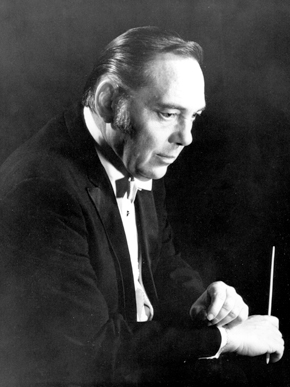
One of the most striking elements of the Bob Bailey years of Yours Truly, Johnny Dollar is its use of music. This can be credited, at least in part, to the input of Musical Supervisor Amerigo Marino. The regard those making the show, especially writer/producer Jackstone, had for Amerigo is underscored by the memorable 5-part story The Ricardo Amerigo Matter, the only Johnny Dollar case to explicitly refer to a member of the show's production crew. Amerigo, who was born in 1925 and worked for CBS for many years, is somewhat unique among the key figures of the show's mid-50s heyday. While Bob Bailey and Jack Johnstone for the most part withdrew from the spotlight after the end of the golden age of radio, Amerigo arguably went on to much bigger things. In 1964, he became the Music Director and Conductor of the Alabama Symphony Orchestra, a role he held for two decades during which the ensemble - and Marino himself - attained national acclaim.

Thursday, February 28, 2013

Rethinking the Golden Age

Like many old-time radio fans, I've tended to think of the golden age of radio as a single amorphous era. As I've been researching for this project, an intriguing book by radio historian Jim Cox entitled Say Goodnight Gracie: The Last Years of Network Radio has made me realize how important seeing radio's heyday as a series of eras within the larger era is to understanding the development of old-time radio and Yours Truly, Johnny Dollar in particular.

The show's early years intersected with the period where television was truly starting to erode the mass audience for whom radio had been the primary form of entertainment. As the 1950s went on, many long-running radio shows ended, including icons like The Shadow. Some found a second life to television, while others simply vanished. Much of this was driven by the sponsors who once supported the lion's share of radio programming deciding that television was where they wanted to put their resources. And though many classic shows suffered as a result, there was also a curious, and in some ways beneficial, flip-side to that shift.

Though both audience sizes and sponsor support for radio programming were declining, there was still a substantial audience for the networks to serve and - more to the point - airtime that the networks needed to fill and, as much as possible, fill cheaply. Those factors turned out to be a genuine boon for radio drama. Unlike the star-driven music and variety programs which required large (i.e. expensive) casts and orchestras, dramas could be made for a fraction of the cost. Cox cites the average weekly production cost of a variety program as $40,000, whereas a detective series might only cost $4000-$7000. Clearly, the economics favored scripted drama (a marked contrast to today's TV environment but that's another story).

It wasn't just economics that benefited the detective show and other dramatic genres, which is of particular note for Yours Truly, Johnny Dollar. By the middle of the decade, the audience that was still loyal to radio drama was also a more discerning audience that desired more substantive story-telling of the kind offered by writer-driven programs like Gunsmoke and X Minus One. This was the environment into which Bob Bailey and Jack Johnstone stepped in 1955 when the program began its year-long run of character-driven long-form narratives. As we know, it turned out to be the perfect one. That the same factors that ultimately doomed radio-drama in America were also a factor in some of its greatest shows is the sort of irony that would have been appreciated the character Bob Bailey played (and Jack Johnstone wrote) so well.

Monday, February 18, 2013

The Casting as Destiny Matter

A few weeks back I had the honor of interviewing broadcasting legend (and Radio Hall of Fame inductee) Ed Walker. walker is the current host of WAMU's weekly old-time radio showcase The Big Broadcast and by extension the man who introduced me (and many others) to Yours Truly, Johnny Dollar. Among the many topics discussed was, of course, Bob Bailey. Mr. Walker had some interesting observations about the man who's the consensus pick among fans as the best of the many actors to portray Johnny Dollar. Check back soon for more excerpts from the ongoing interviews for The "Whatever Became of Johnny Dollar?" Matter.


Saturday, February 9, 2013

The Man with the Action-packed Expense Account (and a Big Heart)

One of the big differences in American broadcasting between today and the golden age of radio is that back then popular shows actually aired new episodes around the holiday season. Yours Truly, Johnny Dollar was no exception, and the season often found Johnny Dollar with his heart on his sleeve, especially during Bob Bailey's tenure. Sometimes the stories were overtly Christmas themed, as in 1956's "The Missing Mouse Matter", but even if they weren't Johnny's cases could still tug at your heart.

A case in point is the episode that aired the week before "The Missing Mouse Matter". "The Rasmussen Matter" tells the story of a dying man grieving for a dead son and consumed by the mystery of a daughter-in-law he's never met. It should surprise no one that Johnny Dollar is up to the challenge of solving this particular mystery, however, the path the script by E. Jack Neuman (aka John Dawson) takes him on is among the show's best and by extension among the best of radio drama.

If you're a fan and haven't heard it, you owe it to yourself to listen to it. If you're a fan and you have heard it, you owe it to yourself to listen to it again.